
 |
| Photo of the Week A composite image of the Japanese destroyer, the Fumitsuki. Sunk in 1944 in Truk Lagoon, this WWII era warship is a rare find filled with history. This image was created by splicing together 33 hi-resolution RAW files. The finished size at 100 percent is more than 12 feet in length. (Scroll down for Top Ten Story and Photo Tip of the Week) |
A Few Words First
 If you haven't already heard the news, sadly, this is to be my last season with Olympus Dive Center. I have recently been offered and have accepted a job in the Micronesian island nation of Palau starting in September of this year. If you would like to know more about this please see this link to my most recent newsletter.
I still have the 2012 dive season left in North Carolina and I am very excited to get things going. In fact, I just finished running my first three charters of the season on the Midnight Express and so far so good. On Friday May 4th we got things off with a bang by venturing offshore to the WE Hutton aka Papoose where we had a modest 30' of visibility with water temps in the low 70's. This is surprisingly warm for early May. We followed up with our second dive on the mainstay wreck site, the U-352 where conditions were about the same.
Word must be getting out in the world about how good the diving in North Carolina is since we had an international crowd on board the 'Midnight' over the weekend. If I'm not mistaken we had divers from Denmark, Finland, Canada, Chile and even that far out country of New Joisey. I believe there was also a no-show from Peru. I for one think it is fantastic that Olympus is attracting divers from outside our borders. Bring all your friends please and if I guessed your country of origin incorrectly please accept my apologies.
On Saturday we dived twice the wreck of the USCG Cutter Spar. This was my first trip out to the Spar since hurricane Irene in August of 2011. The ship has moved several hundred feet and rolled nearly on to her side. The visibility was a handsome 40 feet or better (depending on who you speak to) with water temps in the mid 70's. There was a fair amount of surface current and some choppy seas to help sharpen the divers skills on board but most all had a great experience on one of North Carolina's favorite wreck sites. There were stingrays, sand tiger sharks and plenty of small fish about.
Sunday brought strong winds out of the north so we stayed close to the beach and dived the USS Indra and the wreck of the Suloide in 60' of water. With visibility around 15 feet divers were able to salvage this day and go diving rather than sit at the dock. To me, any diving is better than no diving and besides most on board were very pleased with their dives and some managed to spot a large and rare sand bar shark. Way to go!
In this weeks Dive Blog Report the countdown of my Top Ten Dives of all time continues. Coming in at No. 3 is the wreck of the Japanese destroyer, Fumitsuki. This WWII warship is a rare find in the world and can be seen mostly intact in the waters of Truk Lagoon. This is not about any one dive experience, but about the wreck site as a whole. She is my favorite dive in Truk Lagoon. Read on and find out why
(Some weeks ago I already published a story on the Fumitsuki on scubaboard.com, so I thought I would merely repost to my blog report. If you have already read it then you may want to scroll down to the bottom for my Photo Tip of the Week section.)
(Some weeks ago I already published a story on the Fumitsuki on scubaboard.com, so I thought I would merely repost to my blog report. If you have already read it then you may want to scroll down to the bottom for my Photo Tip of the Week section.)
Happy Diving!
-Mike Gerken
No. 3:
The Fumitzuki of Truk Lagoon (Video)
The Fumitsuki Destroyer:
A Fight for Survival
Text & Photos by
Mike Gerken
©All rights reserved.
 |
| The bow of the Fumitsuki as seen in 2007. |
The initial
time I set eyes on the wreck of the Fumitsuki,
I knew she was remarkable. Sitting erect in 120 feet of seawater on the sandy
bed of Truk Lagoon in Micronesia, this World War II Japanese destroyer was a physical
archive of history standing before me. Canons with boxes of shells nearby,
anti-aircraft guns, torpedo launchers, depth charges and personal effects from
within the wreck, are only a few of the interesting items to be seen.
Rarely
will you find anywhere in the world a Japanese war ship that is as fully intact
and loaded with artifacts such as the Fumitsuki. In 2003, I dived the wreck during my first
week of employment on board the liveaboard dive vessel, the Truk Aggressor II; I immediately knew this wreck was going to be my personal
favorite. For the next six years working in Truk, I would log nearly two
hundred dives on the Fumitsuki and
discover a new and interesting facet about her each and every time.
The Fumitsuki was one of twelve Mutsuki class destroyers built in 1926
during an era when the Japanese were evolving in to a world military power. With
an overall length of 320 feet, a top speed of 33 knots and armed with six 24”
torpedo tubes (3 fore and 3 aft), this class of destroyer was a formidable
weapon. In addition, the Fumitsuki
was armed with 4 - 4.7” 50 caliper canons, 10-25mm anti-aircraft guns,
minesweeping equipment and depth charge capabilities. Whereas Japanese
battleships were given names of mountains or provinces, destroyers were named
after meteorological events such as the Fuyutsuki,
(Winter Moon), the Tachikaze (Earth
Severing Wind) or the Fumitsuki
(Month of the Rice Flower) whose literal translation is the month of July.
In 1941,
the aging Mutsuki class destroyers
were pulled from front line duties. The Fumitsuki
was re-equipped with additional depth charges while two of her canons and one
torpedo launcher were removed in her conversion to an escort destroyer and
troop transport. The destroyer fleet,
totaling no more than 130 ships at any point in the war, had the distinction of
being the workhorses of the Japanese Imperial Navy and were incremental in
winning numerous historic naval campaigns in the early stages of WWII. The Fumitsuki and the many other escort
destroyers, with their high-speed capabilities, played a valuable role in
delivering supplies and troops quickly and efficiently to the numerous island
nations spread out over a vast area that was the Pacific theatre of battle. She
would be damaged in the course of her service three times in 1943, but would
return each time to full duty. In January of 1944, the Fumitzuki and one other destroyer, reported being attacked by more
than 80 US aircraft; shooting down 10 of them. This victory would be short lived.
Soon thereafter, the Fumitsuki would be transferred to the
Japanese naval stronghold of Truk Lagoon to receive repairs from damage
sustained in an attack at Rabaul, New Guinea, a location then under heavy
allied assault. It was here, at Truk, in the repair anchorage, that the Fumitsuki would encounter the onslaught
of US air power on the morning of February 17, 1944.
Truk Lagoon
was Japan’s largest outlying military facility during the war. It’s 140 miles
of barrier reef with deep anchorages within made it ideal as a naval and air
facility. As WWII progressed, Japan found themselves in a full retreat and by
early 1944, Truk Lagoon became the next likely target for US forces advancing
rapidly across the Pacific. The Japanese commanders then deemed Truk unsafe for
their naval warships and evacuated the fleet from the lagoon.
 |
| A US Dauntless Dive Bomber over Truk Lagoon. |
On February
17, 1944, a carrier based aerial assault, codenamed Operation Hailstone, was carried out by a force of more than 400 carrier
based US planes on Truk. For the next 48 hours more then three-dozen merchant
ships (also known as Maru’s) would be sent to the bottom of the lagoon and 280
planes destroyed in the air and on the ground. The Fumitsuki would also perish in the attack, but not before putting
up a fight. This valiant struggle to survive is far more compelling story than those
of the merchant ships who were mostly unable to defend themselves and were sunk
while at anchor.
 |
| The Fumitsuki in the repair anchorage. |
The worst
thing that can befall a wartime captain is to have his vessel caught at anchor
during an air raid. Unable to maneuver, the captain and ship would be a sitting
duck at the mercy of the attackers. Commander Nagakura of the Fumitsuki would find himself in this
quandary on that early morning of the attacks. Unable to make way, due to
repairs being facilitated, the Fumitsuki defended
itself to the best of its ability by opening fire upon the assaulting planes
with anti-aircraft guns.
Later in
the morning, with the use of only one engine, the Fumitsuki managed to get
underway. While under relentless machine gun fire from US planes, the Captain attempted
to maneuver his ship in a zigzag pattern into the safety of open water. She
managed to avoid direct hits of up to four aerial bombs, but one near miss
struck close to her port stern and inflicted enough damage to cause the ship to
take on water in the engine room and loose headway.
 |
| The Fumitsuki under attack by US planes. |
It is this
piece of history along with my creative imagination that propelled the Fumitsuki into the status of my
‘favorite wreck dive’ in Truk Lagoon. As I swim down the length of the wreck, I
see the chaotic scene of planes strafing the deck of the ship while the crew
scramble for cover. Aerial bombs are exploding all around with near misses sending
plumes of water in to the air before raining down upon ship. I can visualize
the crew darting to and fro upon the deck tending to wounded sailors, manning
the guns and fighting with tenacity for their very survival. I peer in to the
remains of the wheelhouse and envision the captain firing off commands in
rapid-fire succession to his officers while trying to maintain his composure.
 |
| The Fumitsuki under attack. |
Midway down
the wreck, the anti-aircraft gun deck is a beehive of activity with twin 25mm
guns blazing away in a deafening rattle while the smoke clears away under the
strong breeze gusting over the deck. The scene that is unfolding before me is
not thrilling or glorious, but miserable and horrid -- the way war always is.
When I
penetrate in to the tight confines of the living quarters under the foredeck, I
see the tiny fold down racks where the sailors slept. I think to myself, “what
was it like trying to sleep so far forward in a destroyer in rough seas?” The
pitching and yawing of the vessel would toss you around violently unless
strapped in to your bunk. I spoke to an American Navy veteran some
years ago who served on a destroyer after WWII. He said when crews from other branches of the navy
returned to port they went out on the town to celebrate while destroyer crews
went to sleep. Life on board at sea was just too exhausting to think about
doing anything else when first back on land.
 |
| A sailors rack in the bow. |
Within the
wreck there are numerous historical artifacts to be found. The state of Chuuk,
as Truk Lagoon is known today, has declared the wrecks a national treasure
making it illegal to remove anything from them. Since they cannot be taken, honest
divers, conveniently display artifacts they have discovered at strategic points
around the wrecks for others to enjoy. Although many artifacts have been stolen
over the years, the wrecks still hold many treasures within.
During my
many explorations of the Fumitsuki, I
have found medical kits fully stocked with bottles and supplies, instruction
manuals still legible, lamps with intact bulbs that once illuminated the living
spaces, numerous types of bottles, shoes, ammunition, electric fans and even human
remains. It is a sobering reminder for me as to what took place here when I
come across the bones of another. I think that this individual may have died
more from the reckless leadership of generals and politicians and less from a
bullet or bomb from a US plane.
 |
| A desk and intact light bulb. |
Diving the Fumitsuki is not exclusively about
bombs, bullets and mayhem. When I snap out of my imaginary state I find myself
surrounded by the reality of what this wreck has become today. She is blanketed
with an array of marine life such as sea fans, soft corals, black corals and
magnificent sea anemones. Many fish species such as the noble napoleon wrasse, the
peculiar looking guitar shark and schools of marauding emperor fish are seen
with regularity.
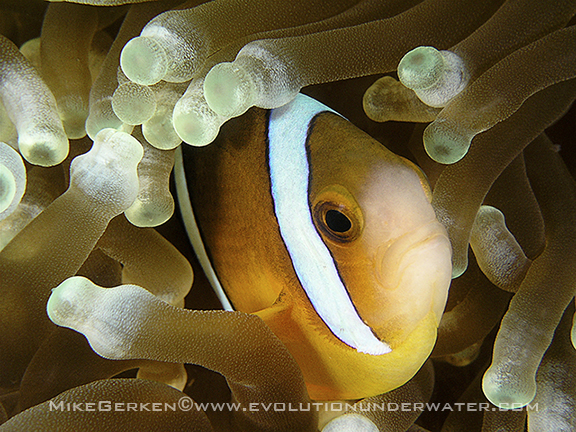 |
| A Clark's Anemone Fish. |
This wreck,
for me, is full of these contrasting images. One minute I’m contemplating the
brutality of war while the next, I’m absorbed in a fanciful moment with a beautiful
pink anemone fish darting in and out of the lush tentacles of its host. It is
surreal down there with limitless entertainment mixed in with moments of
reflection. The Fumitsuki is indeed
an interesting shipwreck, but the stories of this wreck and others like her are
not always apparent. With a little research and a keen imagination anyone can
find the fascinating history lurking within their remains.
A video excerpt from the documentary film,
 |
| The Wrecks of Truk Lagoon - DVD Order Your Copy Today! |
Several years ago, time had taken its toll on the Fumitsuki.
The bow section of the wreck was reported to have collapsed opening up the forward
section. Much of what is described here and the photos posted are inaccurate to
how the ship appears today. The author has yet to see the wreck in this altered
state.
Archival images:
All archival images and film courtesy of the National Archives &
Records Administration, Washington, D.C.
Referenced Works:
The WWII Wrecks of the
Truk Lagoon; authored by Dan Bailey; copyrighted 2000.
Japanese Destroyer
Captain; authored by Captain Tameichi Hara; copyrighted 1961.
Photo Tip of the Week
Backing Up Your Images
When I used to work on liveaboards in Truk Lagoon every so often someone would come up to me with a large frown on there face holding a camera with water dripping off of it. In the digital age there is little than can be done to save a camera that has been immersed in water. I would ask them, "Do you have insurance?". Sometimes they would answer yes, but that didn't seem to matter. What they were most upset about was all of their photos from the entire week were on the storage card inside the now wet camera and completely lost. I then would ask, "Did you back up your files?" Inevitably, many would shake their head and frown even more. Not only did they not back up their photos but they never even downloaded them off the camera in the first place.
At the end of a dive or at the least, at the end of a dive day, one should always download their images on to an external source such as a laptop. Once that is complete back them up on to another hard drive. Then you can format your storage card and get ready for another photo shoot. You should never use a storage card as a long term place to store your images. They are not reliable enough and every time you take your camera in the water you run the inherent risk of flooding and thus destroying the storage card as well.
Your files should exist in two separate places at any given time always! I take it a step further and keep another hard drive in a separate home and update it every so often. There are also internet services out there where you can upload and store unlimited data on external sites for a small yearly fee and access them easily enough when you are logged in to the net. Whatever you decide to do be sure to back your images up and then back them up again. You will be grateful you did so if a catastrophe should occur.
Good luck!
-Mike


